Last checked: August 2026
Choosing between Octopus Energy tariffs can initially look more complicated than choosing between the standard fixed and variable deals offered by many energy suppliers. Octopus offers those conventional options, but it also has a growing range of smart tariffs designed around electric vehicles, heat pumps, solar panels, battery storage and households that can change when they use electricity.
That choice is one of the reasons it is worth understanding the Octopus Energy tariffs before switching. The cheapest or most suitable option for one household may be completely different for another. Someone who simply wants predictable energy prices is unlikely to approach the decision in the same way as an EV owner who can charge overnight or a household with solar panels and battery storage.
Current Octopus Energy tariffs include conventional fixed and variable options alongside products such as Octopus Tracker, Agile Octopus, Intelligent Octopus Go, Cosy Octopus and several export tariffs. Some provide greater price certainty, while others offer the potential to take advantage of cheaper periods by changing when you consume electricity.
This guide explains the main Octopus Energy tariffs available in 2026, how fixed, flexible and smart tariffs differ, what to consider when comparing Octopus Energy prices and which types of household may want to investigate each option.
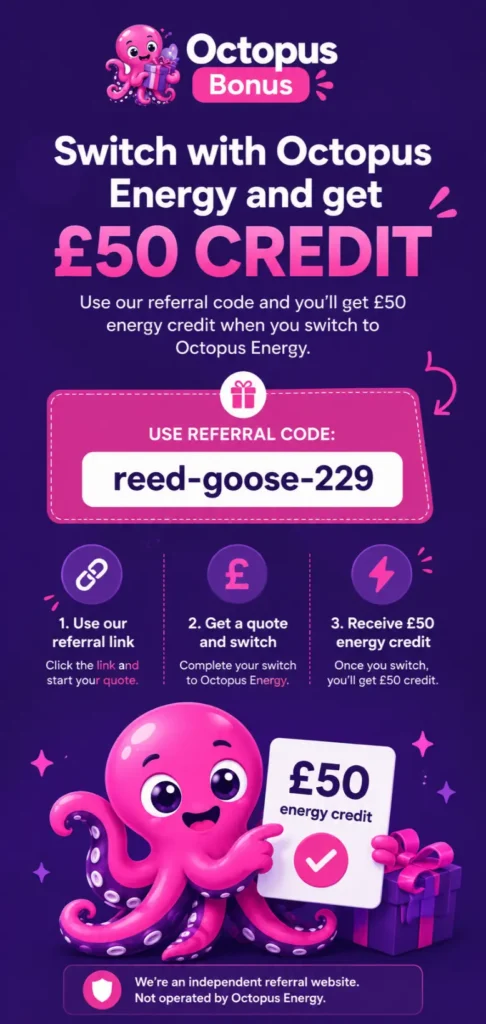
If you ultimately decide Octopus is right for you, eligible new customers can also receive £50 energy credit through the current referral offer. Our referral code is reed-goose-229, but I would choose the tariff first and treat the referral credit as an additional benefit rather than the reason for switching.
Independent website disclosure: OctopusBonus.co.uk is an independent referral information website and is not owned, operated or endorsed by Octopus Energy. We may receive a referral reward when an eligible customer switches using our referral link. Tariffs, prices, eligibility and referral offers can change, so always check the current information and quote provided by Octopus Energy before switching.
Contents
- What Octopus Energy tariffs are available?
- Fixed vs Flexible Octopus Energy tariffs
- How does Flexible Octopus work?
- How do Octopus Energy fixed tariffs work?
- What are Octopus Energy smart tariffs?
- How does Octopus Tracker work?
- How does Agile Octopus work?
- What is Intelligent Octopus Go?
- Which Octopus tariff is designed for heat pumps?
- Octopus tariffs for solar panels and batteries
- How do you compare Octopus Energy prices?
- Which Octopus Energy tariff should you choose?
- What should you check before switching?
- Can you get £50 credit when switching?
- Octopus Energy tariff FAQs
- Conclusion
What Octopus Energy Tariffs Are Available?
There isn’t one Octopus Energy tariff that is automatically the right choice for every household. The current range can broadly be separated into three groups: fixed tariffs, variable tariffs and smart tariffs.
A conventional Octopus Energy fixed tariff provides greater certainty because the unit rates and standing charge remain fixed for the agreed tariff period. Your actual bill can still change because it depends on how much energy you use, but the rates themselves are fixed for the relevant term.
Flexible Octopus works differently. It is a variable tariff, meaning its prices can change rather than being locked in for a fixed term. Octopus explains that Flexible prices generally move every three months in response to changes in wholesale energy prices.
Then there are the Octopus Energy smart tariffs.
These are where the tariff range becomes considerably more interesting. Rather than simply charging a conventional rate for electricity throughout the day, some Octopus Energy tariffs use different prices at different times or track movements in the wholesale energy market.
Current smart options include Octopus Tracker, Agile Octopus, Intelligent Octopus Go, Cosy Octopus and tariffs associated with solar generation, batteries and electricity export. Octopus also has Snug Octopus for compatible storage heaters.
The range means that choosing between Octopus Energy tariffs is partly about understanding your own household.
Do you value predictable rates? Can you move electricity consumption away from expensive periods? Do you drive an electric vehicle? Do you have a heat pump? Are there solar panels on your roof? Do you have battery storage?
Those questions can be more useful than simply asking which Octopus Energy tariff has the lowest advertised rate.
For example, a household with an EV could potentially benefit from a tariff designed around overnight charging. A household with a heat pump has different requirements, while someone who enjoys actively managing appliances around changing electricity prices may be more interested in Agile.
Someone who wants very little involvement, by contrast, may prefer the relative simplicity of a fixed or flexible tariff.
That’s why this guide considers the main Octopus Energy tariffs individually rather than attempting to declare one universal winner.
Fixed vs Flexible Octopus Energy Tariffs
For households that don’t need a specialist smart tariff, one of the biggest decisions is whether to choose an Octopus Energy fixed tariff or Flexible Octopus.
The fundamental difference is price certainty.
With a fixed tariff, your unit rates and standing charge remain fixed for the duration of the contract. Octopus says its fixed tariffs usually run for a defined period, commonly around 12 months, although the products available when you obtain a quote can change.
This doesn’t mean your energy bill is fixed.
If you use more gas or electricity, your costs can increase. If you use less, they can decrease. It is the tariff’s applicable unit rates and standing charge that are fixed rather than the total amount you will pay over the year.
Flexible Octopus takes a different approach. It is a variable tariff, so prices can move in response to changes in energy costs. Octopus says Flexible prices generally change every three months.
The advantage of fixing is therefore greater certainty. If energy prices increase after you fix, your agreed rates don’t simply increase in response to the next price cap movement.
The trade-off is that market conditions can also improve. If cheaper deals become available later, you may want to move before your fixed period has ended.
That makes exit fees worth checking.
Octopus has historically offered many fixed tariffs without exit fees, but that isn’t something you should automatically assume. In March 2026, Octopus reintroduced exit fees on some newly offered fixed tariffs following significant energy market volatility. Existing tariff terms weren’t retrospectively changed.
So when comparing Octopus Energy tariffs, don’t look only at the initial estimated annual cost.
Ask yourself how much you value certainty, whether you would be comfortable with variable prices and whether the fixed tariff you’re considering has an exit fee.
There isn’t a universally correct answer. It depends partly on your attitude to price movements and the specific Octopus Energy prices available when you obtain your quote.
How Does Flexible Octopus Work?
Flexible Octopus is Octopus Energy’s standard variable tariff.
Unlike an Octopus Energy fixed tariff, Flexible doesn’t lock your unit rates and standing charge at the same level for a fixed contractual period. Prices can change, with Octopus explaining that the tariff generally moves every three months alongside changes in underlying energy costs.
Flexible Octopus is also affected by Ofgem’s energy price cap.
The price cap is often misunderstood because it isn’t a cap on the maximum amount your household can spend on energy. Your bill still depends on how much gas and electricity you use.
Instead, the cap limits the rates suppliers can charge customers on applicable default variable tariffs.
As of summer 2026, Octopus states that it remains the only large supplier never to have charged customers the full Ofgem price cap on its flexible tariff. That is an Octopus claim and doesn’t mean Flexible Octopus will necessarily be the cheapest available tariff for your individual circumstances.
One advantage of Flexible is flexibility in the everyday sense too. Octopus currently describes the variable tariff as having no exit fees, so customers aren’t tied into the tariff in the same way they might be with a fixed product carrying an early exit charge.
That can make Flexible Octopus worth considering if you don’t want to commit to a fixed tariff or if you want the ability to change when another suitable option becomes available.
The downside is uncertainty.
If variable energy prices rise, the rates you pay can rise too. Someone who values knowing their unit rates won’t change during a fixed term may therefore prefer to compare the current fixed options.
Flexible Octopus is consequently neither automatically better nor worse than the fixed Octopus Energy tariffs. The choice depends on the rates available at the time and whether you prioritise flexibility or price certainty.
How Do Octopus Energy Fixed Tariffs Work?
An Octopus Energy fixed tariff locks in your unit rates and standing charge for the duration of the tariff agreement.
This is one of the simpler Octopus Energy tariffs to understand because you aren’t required to shift electricity usage into particular periods or follow daily wholesale energy prices.
Once you’re on the tariff, the rates remain fixed for the relevant contract period. Your monthly Direct Debit can still change because it is based on the amount of energy Octopus expects you to use and the balance on your account.
That distinction is important.
Suppose your household starts using considerably more energy after joining an Octopus Energy fixed tariff. Your total annual energy cost can still increase because you’re consuming more units, even though the price charged for each unit hasn’t changed.
At the end of the fixed period, Octopus says it will provide notice of the options available. If you don’t select another tariff, you can be moved onto a flexible tariff.
Whether fixing is attractive depends on the deal available when you’re looking to switch.
If fixed rates are competitive and you value certainty, fixing can provide reassurance that the tariff rates won’t suddenly change during the agreed period.
On the other hand, fixing isn’t a prediction that energy prices are about to rise. Wholesale markets can move in either direction, and cheaper tariffs could become available later.
You should therefore check any exit fee attached to the particular Octopus Energy fixed tariff you’re considering.
Octopus says exit fees on new fixed tariffs, where applicable, are clearly shown before a customer switches. It also confirms that customers whose existing fixed tariff didn’t contain an exit fee haven’t had one retrospectively added.
For many households, the decision between fixed and flexible will come down to a fairly simple question: would you rather have greater certainty about your energy rates, or greater freedom to respond to changing prices?
What Are Octopus Energy Smart Tariffs?
Octopus Energy smart tariffs are one of the main things that differentiate the company’s tariff range from a straightforward choice between fixed and variable energy.
Instead of charging electricity in exactly the same way throughout the day, smart tariffs can use information from a smart meter to offer different rates at different times or reflect movements in wholesale electricity prices.
Octopus currently offers smart tariffs designed around several different household situations, including EV ownership, heat pumps, solar generation, battery storage and households capable of moving their electricity use away from peak periods.
These Octopus Energy tariffs can be attractive because electricity isn’t equally expensive to produce at every moment of the day.
When demand is high, electricity can be more expensive. At other times, particularly when renewable generation is plentiful and demand is lower, wholesale electricity can be cheaper.
Smart tariffs can create an incentive to use electricity during those cheaper periods.
That could mean charging an EV overnight, heating water at particular times, scheduling a washing machine or dishwasher, charging a home battery when electricity is inexpensive or exporting stored electricity when export rates are more attractive.
The potential benefit depends on how flexible your household actually is.
If you can automate appliances and move substantial electricity consumption into cheaper periods, some Octopus Energy smart tariffs can be worth investigating. If most of your consumption has to happen during expensive periods and can’t be shifted, the same tariff could be much less attractive.
Smart tariffs can also involve additional eligibility requirements. A compatible smart meter capable of sending the necessary consumption data is generally central to time-of-use pricing, and specialist products can have further technology requirements.
So rather than thinking of “smart tariff” as automatically meaning “cheap tariff”, think of it as a tariff that gives you more opportunity to optimise when you consume electricity.
How Does Octopus Tracker Work?
Octopus Tracker is designed to follow wholesale energy prices more closely than a conventional fixed or standard variable tariff.
Octopus describes Tracker as a tariff with daily prices that track the wholesale cost of energy. It can be available for electricity, gas or both.
The important word here is daily.
Unlike a fixed tariff where your unit rate is locked for the relevant term, Tracker prices can change from one day to the next according to the tariff’s pricing formula and underlying market conditions.
This can be attractive when wholesale energy costs are relatively low because customers can potentially benefit from falling prices more quickly than they would on a conventional tariff.
The opposite is also true.
Wholesale prices can rise, which means Tracker isn’t a guarantee of cheaper energy. Anyone considering this type of Octopus Energy tariff should be comfortable with prices changing more frequently.
Tracker is also different from Agile Octopus.
Tracker follows daily wholesale prices, while Agile uses electricity prices that vary at half-hourly intervals. Tracker therefore doesn’t require the same level of active shifting of electricity use throughout the day.
That could make Tracker interesting to someone who wants greater exposure to wholesale pricing but doesn’t want to plan appliance usage around dozens of different half-hourly electricity rates.
However, this is still a more dynamic product than Flexible Octopus or a conventional fixed tariff.
If your priority is knowing exactly what your unit rate will be for the next year, Tracker probably isn’t the first Octopus Energy tariff you would investigate.
If you’re comfortable with daily movements and want a tariff more closely connected to wholesale energy prices, it becomes more relevant.
As always, look at the current tariff terms rather than relying on historical Tracker performance. Previous periods of cheaper wholesale prices don’t guarantee that the tariff will outperform other Octopus Energy tariffs in the future.
How Does Agile Octopus Work?
Agile Octopus is one of the most dynamic Octopus Energy tariffs.
Instead of having one electricity unit rate throughout the day, Agile prices electricity in half-hourly periods. The following day’s prices are updated daily, allowing customers to see when electricity will be cheaper or more expensive.
The tariff is designed for people who can move electricity consumption away from expensive periods.
Octopus specifically highlights shifting energy use away from the typical 4pm to 7pm peak, when electricity demand can be high.
For an engaged household, that creates interesting possibilities.
You might schedule a dishwasher or washing machine for a cheaper period, charge a battery when electricity costs less or move other flexible consumption away from expensive evening hours.
Prices can sometimes become exceptionally low and can even turn negative in certain market conditions. But that shouldn’t obscure the other side of the tariff: prices can also increase.
Octopus explicitly warns in its smart tariff terms that Agile prices can rise as well as fall and that historical performance cannot reliably predict future costs.
That’s why Agile isn’t automatically the best Octopus Energy tariff simply because you’re comfortable using an app.
The biggest question is how much electricity you can realistically shift.
A household where everybody arrives home at 5pm and immediately cooks, heats the home, runs appliances and charges an EV may have a very different consumption profile from a household with batteries, automated appliances and considerable flexibility.
Agile can reward engagement, but it also asks more of the customer.
If you want predictable electricity rates without thinking about when the washing machine runs, a conventional Octopus Energy tariff may be easier to live with.
What Is Intelligent Octopus Go?
Intelligent Octopus Go is Octopus’s smart electricity tariff designed primarily around electric vehicle charging.
Octopus currently describes the tariff as providing smart EV charging alongside six hours of low-cost home electricity every night. The system can schedule compatible EV charging to take advantage of cheaper and greener electricity.
The significant point is that the cheaper period isn’t limited only to electricity entering the car.
During the applicable off-peak period, the lower electricity rate applies to home consumption as well, which can create opportunities to schedule other electricity-intensive activities overnight.
For example, a household might charge its EV while also scheduling a dishwasher, washing machine, tumble dryer or home battery during cheaper hours where safe and practical.
This can make Intelligent Octopus Go particularly relevant to households whose EV represents a substantial part of their electricity consumption.
However, there are eligibility and compatibility requirements.
The tariff relies on Octopus being able to intelligently control or schedule charging through compatible technology, so not every combination of vehicle, charger and meter will necessarily qualify.
If you’re considering this Octopus Energy tariff, check the current compatibility information before basing a switching decision on the advertised off-peak rate.
It’s also worth considering the rest of your household consumption.
An EV tariff can offer extremely attractive charging rates but that doesn’t automatically mean it produces the lowest total annual bill for every EV owner. The peak rate, your non-EV electricity consumption and when you use that electricity all contribute to the overall result.
For EV households, though, Intelligent Octopus Go is one of the Octopus Energy tariffs I would certainly include in the comparison.
Which Octopus Energy Tariff Is Designed for Heat Pumps?
Octopus’s main smart tariff designed specifically around heat pumps is Cosy Octopus.
Heat pumps use electricity to heat a property, so their consumption profile differs from a conventional gas boiler. A tariff designed around that usage can therefore make more sense than simply choosing the cheapest-looking standard electricity rate.
Octopus describes Cosy as a smart electricity tariff designed to make heating a heat-pump home cheaper.
The concept is based around different electricity rates at different times, creating cheaper periods when a household can run its heat pump more economically.
How useful that is depends on the property, heat pump, heating controls, insulation and how effectively the household can make use of the cheaper periods.
A well-designed heat pump system should also be considered as a complete heating setup rather than simply an appliance that gets switched on whenever electricity becomes cheap.
If you already have a heat pump, comparing Cosy Octopus with other Octopus Energy tariffs is worthwhile because heating may represent a significant part of your electricity consumption.
If you’re considering installing a heat pump, don’t choose the technology solely because a particular energy tariff currently exists. Tariffs can change over the lifetime of the heating system.
Octopus also recommends different smart tariffs depending on the combination of low-carbon technologies in a home. For example, its current guidance points EV plus heat-pump households towards Intelligent Octopus Go, while heat-pump and solar households may combine Cosy with an export tariff.
This demonstrates why the broader Octopus Energy smart tariff ecosystem matters. Once a household has several technologies, choosing a tariff becomes less about a single headline unit rate and more about how the whole home consumes, stores and exports electricity.
Which Octopus Energy Tariffs Suit Solar Panels and Batteries?
Solar panels and home batteries introduce another consideration because your household may both buy electricity from the grid and sell electricity back to it.
That means comparing Octopus Energy tariffs purely on the import price can give an incomplete picture.
Octopus offers export tariffs including Outgoing Octopus, which allows eligible households to receive payment for electricity exported to the grid. It also offers Octopus Flux, which is designed around households with solar generation and battery storage.
For a solar household, the important question is how much of the electricity you generate you use yourself and how much you export.
Self-consuming solar electricity can reduce the amount you need to buy from the grid. If you have surplus generation, the export rate determines what you receive for sending that electricity back.
Adding a battery creates more flexibility.
Instead of immediately exporting surplus solar electricity, you may be able to store it for later. Depending on the tariff and setup, batteries can also potentially be charged from the grid during cheaper periods and used when grid electricity is more expensive.
Octopus’s current smart tariff guidance suggests Agile combined with Outgoing Octopus for some battery-storage households, while Octopus Flux is specifically associated with solar and battery storage.
The best arrangement depends heavily on your hardware and consumption profile.
A household generating large amounts of surplus solar electricity may place greater importance on export rates. Another household may consume most of its solar generation directly and care more about the price of electricity imported when solar production is low.
This is why solar households should compare the overall import-and-export proposition rather than simply looking for the lowest advertised Octopus Energy prices.
How Do You Compare Octopus Energy Prices?
Comparing Octopus Energy prices requires more than looking at one headline figure.
For a conventional tariff, start with the unit rate. This is the amount you pay for each kilowatt hour of electricity or gas you consume.
Then look at the standing charge. This is a daily amount charged regardless of how much energy you use.
Both matter.
A household with relatively low consumption may be more sensitive to the standing charge because it represents a larger proportion of the total bill. A high-consumption household may be more heavily influenced by differences in unit rates.
Location matters as well. Energy rates can vary by region, which is one reason I wouldn’t recommend relying on a generic national Octopus Energy price quoted in an article.
Use your postcode and actual or estimated annual consumption to obtain a personalised quote.
For smart Octopus Energy tariffs, the comparison becomes more complicated because the price you pay can depend on when you consume electricity.
A simple annual estimate based on one unit rate may not accurately capture the potential value of Agile, Intelligent Octopus Go or another time-of-use tariff.
Your consumption profile becomes important.
How much electricity do you use overnight? How much falls between 4pm and 7pm? Can an EV or battery be charged automatically? Can you schedule appliances? Do you work from home during the day?
The answers can materially change which Octopus Energy tariffs look attractive.
Finally, check the contractual details. Exit fees, fixed-term periods, smart-meter requirements and technology compatibility can all matter.
The tariff with the lowest-looking rate isn’t necessarily the tariff that produces the best overall result for your household.
Which Octopus Energy Tariff Should You Choose?
There is no single Octopus Energy tariff I would recommend to every household.
Instead, narrow the range according to what you actually need.
If your priority is price certainty, start by comparing the current Octopus Energy fixed tariff options. You know the applicable unit rates and standing charge will remain fixed for the agreed period, although your total bill will still depend on consumption.
If you want flexibility without committing to a fixed term, Flexible Octopus is the obvious conventional tariff to investigate. Its prices can change, but Octopus currently applies no exit fee to Flexible.
If you want exposure to daily wholesale energy prices, look at Octopus Tracker.
If you’re prepared to actively move electricity use between different times of day, Agile Octopus deserves consideration.
For an electric vehicle household, Intelligent Octopus Go may be particularly relevant because of its smart charging and overnight low-cost electricity periods.
For a heat pump, investigate Cosy Octopus.
For solar panels, consider your export arrangement as well as the import tariff.
For solar plus battery storage, products such as Flux or combinations involving Agile and Outgoing Octopus may be worth comparing.
Households with compatible storage heaters can also investigate Snug Octopus.
The important word throughout that list is “consider”.
None of these labels guarantees that a tariff will be cheapest for you. Your consumption, region, technology and behaviour determine the outcome.
That’s why I would use Octopus’s current quote and tariff information rather than selecting a tariff based entirely on somebody else’s savings claim.
The right Octopus Energy tariff is the one whose pricing structure best matches your household, not necessarily the one with the most impressive headline rate.
What Should You Check Before Switching to an Octopus Energy Tariff?
Before choosing between Octopus Energy tariffs, start by checking your current energy situation.
Find your recent annual gas and electricity consumption if possible. Comparing tariffs using actual consumption gives you a more meaningful estimate than relying entirely on generic household assumptions.
Next, compare the unit rates and standing charges.
If you’re considering an Octopus Energy fixed tariff, check the length of the fixed period and whether an exit fee applies. Don’t assume that every Octopus fixed tariff has the same exit conditions.
For Flexible Octopus, understand that prices can change.
For Tracker and Agile, make sure you’re comfortable with more frequent price movements.
If you’re considering an Octopus Energy smart tariff, check the technical requirements carefully. A smart meter is central to these products, and specialist tariffs such as Intelligent Octopus Go can depend on compatible vehicles or chargers.
Then think realistically about your behaviour.
It’s easy to look at cheap off-peak electricity and imagine moving all your consumption into those periods. In practice, households still need to cook dinner, use lighting and run equipment when they need it.
Base your decision on the consumption you can realistically shift rather than an idealised version of how you might use energy.
Check gas separately too.
Several of the most interesting Octopus Energy smart tariffs focus on electricity. If your household uses gas for heating and hot water, you still need to consider the gas tariff alongside the electricity proposition.
Finally, don’t allow a switching incentive to override the tariff comparison.
The current £50 Octopus referral credit is useful, but saving a relatively small amount on an introductory incentive isn’t worthwhile if another tariff would be materially more suitable for your household over the longer term.
Can You Get £50 Credit When Switching to an Octopus Energy Tariff?
Yes. Eligible new domestic customers can currently receive £50 energy credit when joining Octopus through a qualifying referral.
Octopus’s current referral information confirms that a home referral provides £50 credit to the new customer and £50 to the existing customer making the referral.
Our Octopus referral code is: reed-goose-229
If you’ve compared the available Octopus Energy tariffs and decided you want to switch, you can visit our Octopus Energy referral code page to access the referral link and see how the offer works.
The referral reward isn’t normally applied immediately when you request a quote.
Octopus says the new customer needs to be on supply and have their first month’s Direct Debit successfully taken before the referral credit is automatically applied. It says the overall process typically takes around four weeks, although switching delays can make it longer.
It’s also important to use the appropriate referral route.
Octopus states that customers need to sign up directly through the referral link rather than joining through a third-party switching website if they want the standard referral reward associated with that link.
For a full explanation of eligibility, timing and how the referral works, see our Octopus Energy refer a friend guide.
The key point for this article is simpler: choose between the Octopus Energy tariffs first. Once you’ve found an option you’re happy with, the £50 referral credit can make that switch slightly more attractive.
Octopus Energy Tariff FAQs
What Octopus Energy tariffs are available?
Octopus Energy tariffs currently include fixed and flexible options alongside smart tariffs such as Octopus Tracker, Agile Octopus, Intelligent Octopus Go and Cosy Octopus. Octopus also offers tariffs associated with solar export, battery storage and compatible storage heaters.
Which Octopus Energy tariff is best?
There isn’t one Octopus Energy tariff that is best for everybody. The right option depends on your energy usage, attitude to changing prices, smart technology and ability to move electricity consumption into cheaper periods.
Is Flexible Octopus a fixed tariff?
No. Flexible Octopus is a variable tariff. Its prices can change rather than remaining locked at the same rates for a fixed contractual period.
Does Octopus Energy offer fixed tariffs?
Yes. Octopus offers fixed tariffs where the unit rates and standing charge remain fixed for the duration of the relevant contract. The exact tariffs and rates available can change, so check your current quote.
Do Octopus Energy fixed tariffs have exit fees?
Some newly offered Octopus fixed tariffs can have exit fees. Octopus says any applicable fee will be clearly shown before you switch. Flexible Octopus currently has no exit fee.
What is Octopus Tracker?
Octopus Tracker is a tariff where prices track wholesale energy costs and update daily. It can be available for electricity, gas or both.
What is Agile Octopus?
Agile Octopus is a smart electricity tariff with half-hourly prices that update daily. It is designed for households capable of moving electricity consumption away from more expensive periods.
Which Octopus Energy tariff is best for an electric car?
Intelligent Octopus Go is Octopus’s main smart tariff designed around EV charging. It currently includes six hours of low-cost home electricity each night and smart scheduling for compatible EVs and chargers. Check current compatibility before switching.
Which Octopus tariff is designed for heat pumps?
Cosy Octopus is designed around homes with heat pumps. It uses time-of-use pricing intended to make it cheaper to run a heat pump during particular periods.
Which Octopus tariff is suitable for solar panels?
The answer depends on whether you also have battery storage and how much electricity you export. Octopus offers Outgoing Octopus for solar export and Flux for households combining solar generation with battery storage.
Do I need a smart meter for Octopus smart tariffs?
Smart tariffs generally rely on smart-meter data to measure electricity consumption at the intervals needed for time-of-use pricing. Check the eligibility requirements of the specific Octopus Energy tariff before switching.
Are Octopus Energy tariffs cheaper than the Ofgem price cap?
This depends on the tariff and your circumstances. Octopus currently says its Flexible tariff has historically been priced below the full Ofgem cap, but fixed and smart tariffs work differently and shouldn’t be compared solely against the headline price-cap figure.
Can I change my Octopus Energy tariff after joining?
Octopus says eligible customers can normally compare and change available tariffs through their online account. Customers on Flexible can view alternatives, while fixed customers can generally access the tariff-change option within 45 days of the end of their contract.
Can I get £50 credit when switching to Octopus Energy?
Eligible new domestic customers can currently receive £50 energy credit through the Octopus referral programme. Our referral code is reed-goose-229. Check the referral conditions before switching.
Is Octopus Energy regulated by Ofgem?
Yes. Octopus Energy operates within Great Britain’s energy market, which is regulated by Ofgem. The Ofgem price cap applies to relevant standard variable and default domestic tariffs, but it doesn’t mean every Octopus Energy tariff has the same pricing structure.
Conclusion
The range of Octopus Energy tariffs is broader than a simple choice between fixed and variable energy. Alongside conventional options, Octopus offers smart tariffs designed around daily wholesale prices, half-hourly electricity rates, EV charging, heat pumps, solar generation and battery storage.
That variety is useful, but it also means there isn’t one Octopus Energy tariff that should automatically be recommended to everybody.
If you value predictable rates, compare the current Octopus Energy fixed tariff with Flexible Octopus. If you’re comfortable with changing prices, Tracker may be worth investigating. If you can actively shift electricity consumption throughout the day, Agile Octopus offers a very different proposition.
EV owners should investigate Intelligent Octopus Go, while heat-pump households can consider Cosy Octopus. Homes with solar panels or battery storage should look at both import and export tariffs rather than considering only the price of electricity purchased from the grid.
Whichever option you’re considering, compare the actual Octopus Energy prices available for your postcode and consumption. Look at unit rates, standing charges, tariff terms, exit fees where applicable and any technology requirements.
Most importantly, choose the tariff based on how your household actually uses energy.
If you’ve done that and decided Octopus is right for you, the current referral offer can provide an additional benefit.
Our referral code is reed-goose-229, and eligible new customers can currently receive £50 energy credit through a qualifying referral.
Ready to Check the Current Octopus Energy Refer a Friend Offer?
If you’ve finished comparing the Octopus Energy tariffs and want to proceed, visit our Octopus Energy referral code page to see the current referral offer and access the referral link.
You’ll continue to Octopus Energy, where you can obtain your personalised quote and review the Octopus Energy tariffs available to you before deciding whether to switch.
If you want more information about the referral process first, read our Octopus Energy refer a friend guide. Business customer rather than a household? See our Octopus Energy business referral guide instead.
Our forthcoming Octopus Energy review will also take a broader look at the supplier, including factors beyond tariffs and referral rewards.
Information checked: 18 August 2026. Octopus Energy tariffs, prices, exit fees, smart-tariff requirements and referral offers can change. Always check the latest tariff information and personalised quote before switching.