Last checked: August 2026
If you’re considering changing energy supplier, you’ve probably encountered Octopus Energy. It has grown into one of Britain’s largest energy suppliers and has become particularly well known for its smart tariffs, electric vehicle products, renewable energy focus and distinctive pink branding. But popularity alone doesn’t tell you whether it is the right supplier for your household.
This Octopus Energy review looks beyond the referral offer and asks the questions that actually matter before switching. Is Octopus Energy good for customer service? What are its tariffs like? Is the app useful? How does it perform for billing and smart meters? And ultimately, is Octopus Energy worth it compared with staying with your current supplier or choosing an alternative?
There are some strong reasons to consider Octopus. Independent Citizens Advice data for January to March 2026 placed Octopus fourth in its domestic supplier customer-service rankings, with an overall score of 3.67 out of 5. Octopus also has one of the broadest ranges of smart tariffs in the UK, particularly for households with electric vehicles, solar panels, batteries or heat pumps.
There are drawbacks too. No energy supplier gets everything right. Citizens Advice gave Octopus 3.4 out of 5 for billing and metering in the same period, and customer reviews include complaints about billing, smart-meter installations and individual problems taking too long to resolve.
So this isn’t going to be an Octopus review that simply tells you to switch because there is a £50 referral reward available. Instead, we’ll look at the advantages and disadvantages, who Octopus may suit and what you should compare before making your decision.
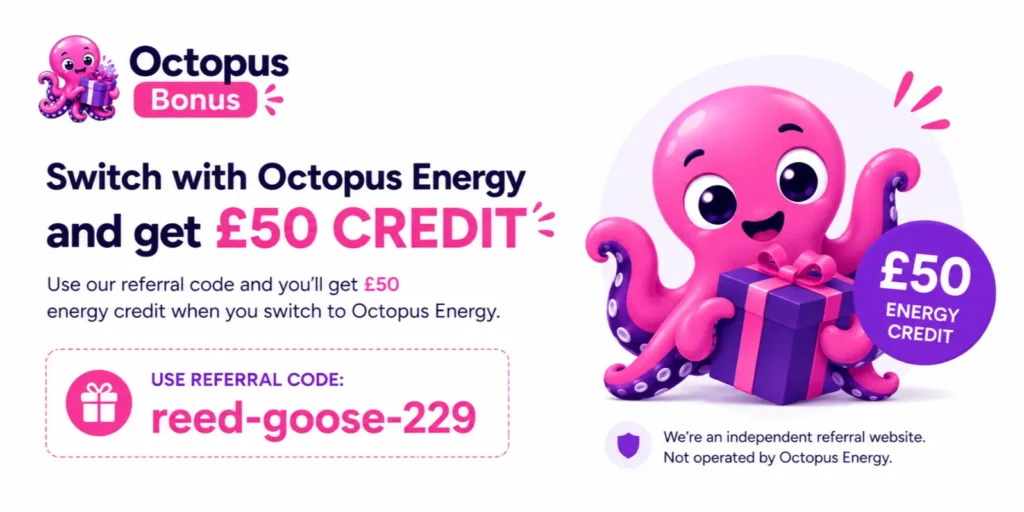
If you eventually decide Octopus is right for you, eligible new domestic customers can currently receive £50 energy credit through a qualifying referral. Our referral code is reed-goose-229, but consider that an additional benefit after you’ve decided whether the supplier itself suits you.
Independent website disclosure: OctopusBonus.co.uk is an independent referral information website and is not owned, operated or endorsed by Octopus Energy. We may receive a referral reward if an eligible customer switches using our referral link. This Octopus Energy review is intended to help readers research the supplier before deciding whether to switch.
Contents
- Octopus Energy review: the quick verdict
- Is Octopus Energy good?
- What is Octopus Energy customer service like?
- What do Octopus Energy reviews say?
- What are Octopus Energy tariffs like?
- Is Octopus good for smart tariffs?
- What is the Octopus app and online account like?
- Billing and smart meters
- How green is Octopus Energy?
- Octopus Energy pros and cons
- Who might Octopus Energy suit?
- Is Octopus Energy worth it?
- Should I switch to Octopus Energy?
- Can you get £50 for switching to Octopus?
- Octopus Energy review FAQs
- Conclusion
Octopus Energy Review: The Quick Verdict
Our overall Octopus Energy review is positive, but with an important qualification: whether Octopus is right for you depends on the tariff available for your household and what you value from an energy supplier.
One of Octopus’s biggest strengths is choice. Someone who simply wants a conventional energy tariff can choose from its mainstream options, while customers with an EV, heat pump, solar panels or battery storage have access to a much more specialised range of Octopus Energy smart tariffs.
Customer service is another positive. Citizens Advice’s latest available domestic supplier data for January to March 2026 gave Octopus an overall customer-service rating of 3.67 out of 5, placing it fourth in the comparison. It scored the maximum 5 out of 5 for customer commitments.
That’s strong, although it is worth putting the result into context. Octopus wasn’t number one. Its billing and metering score was 3.4 out of 5, while its contact waiting-time score was 3.6 out of 5. That gives a more balanced picture than simply saying Octopus has excellent customer service.
Another major strength is innovation. More than one million customers have used an Octopus smart tariff or service, according to Octopus, with products designed around EVs, batteries, solar generation and flexible energy consumption.
The main drawback is that the expanding range can make choosing a tariff more complicated. A household that just wants to know what electricity costs may find products such as Agile, Tracker, Intelligent Octopus Go, Cosy and export tariffs more complicated than a straightforward fixed deal.
For our Octopus Energy review, we’d summarise it like this: Octopus is a strong supplier to consider, particularly if you value smart tariffs and technology, but you should still compare the actual tariff and costs available to your household before switching.
Is Octopus Energy Good?
If you’re searching “is Octopus Energy good?”, there isn’t a meaningful yes-or-no answer that applies to every household. However, there is enough independent evidence to say that Octopus currently performs strongly in several areas.
Customer service is one of them. Citizens Advice ranked Octopus fourth among the domestic suppliers in its January to March 2026 comparison, above the median supplier score. The same dataset recorded 21.3 complaints per 10,000 Octopus customers and showed strong levels of billing accuracy.
Octopus also reported particularly strong results from Ofgem and Citizens Advice customer research published in 2026. According to Octopus’s reporting of the survey, 90% of its customers were satisfied or very satisfied overall and 86% were satisfied with customer service. Because those figures are presented on Octopus’s own website, they should be considered alongside independent comparison data rather than in isolation.
The tariff range is another reason people may answer “is Octopus Energy good?” positively. Octopus has gone much further into time-of-use and technology-specific tariffs than simply offering fixed and standard variable energy.
That matters increasingly as households adopt EVs, heat pumps, solar panels and batteries.
However, being a good supplier doesn’t automatically mean Octopus will be the cheapest supplier for you. Energy prices depend on the tariff, region, consumption and circumstances of the household. A positive Octopus Energy review shouldn’t be interpreted as a guarantee that switching will reduce your bills.
There are also negative customer experiences. Some recent reviews describe problems involving smart meters, account balances, Direct Debit calculations and issues that customers felt took too long to resolve.
That isn’t unusual for a large energy supplier, but it is relevant. The better conclusion is that Octopus performs strongly overall while still having customers who experience problems.
What Is Octopus Energy Customer Service Like?
Customer service deserves particular attention in an Octopus Energy review because the difference between suppliers can become most obvious when something goes wrong.
Energy accounts aren’t always simple. Incorrect meter readings, house moves, disputed bills, smart-meter problems and changes in Direct Debit amounts can all require somebody to intervene.
The latest Citizens Advice data available for this Octopus review covers January to March 2026.
Octopus received an overall customer-service score of 3.67 out of 5, ranking fourth. Its individual scores were 3.5 for fewer complaints received, 3.6 for contact waiting time, 3.4 for billing and metering and 5 out of 5 for customer commitments.
Citizens Advice reported a median score of 3.26 across suppliers for the same period, putting Octopus above that benchmark.
That is a meaningful positive, particularly because the Citizens Advice ranking isn’t based simply on customers voluntarily leaving online reviews. Its methodology incorporates different measures, including complaint information, billing accuracy, smart-meter functionality and customer commitments.
It is also worth noting that Octopus isn’t perfect according to those same figures.
The billing and metering result of 3.4 out of 5 leaves room for improvement. Citizens Advice reported that 96.44% of Octopus smart-meter bills and 94.19% of traditional-meter bills were accurate according to its measure, while 91.49% of smart meters were working correctly.
Our conclusion on customer service is therefore positive rather than flawless. The independent numbers suggest Octopus is performing well relative to much of the market, but individual experiences will inevitably vary.
What Do Octopus Energy Reviews Say?
Looking at customer reviews can be useful, but review websites need to be interpreted carefully.
People are more likely to leave a review after an unusually good or unusually bad experience than after an entirely uneventful year of paying energy bills. Some platforms also contain both invited and unprompted reviews, so a headline rating should never be treated as a scientific measure of every customer’s experience.
Recent Octopus Energy reviews on Trustpilot show many customers praising individual customer-service representatives, response times and the way queries were handled. Other customers report negative experiences involving billing, smart-meter appointments, unexpected account balances or lengthy complaint resolution.
The mixed nature of those experiences is exactly why I wouldn’t base an Octopus Energy review entirely on Trustpilot.
Independent data provides useful additional context. Citizens Advice currently places Octopus towards the stronger end of the domestic energy market for customer service, although not at the very top.
That combination is more informative than selectively quoting five-star Octopus reviews.
It tells us that plenty of customers report good experiences, particularly when dealing directly with customer-service staff, while others have encountered genuine frustrations.
If you’re deciding whether to switch, I would therefore look for patterns rather than individual stories.
Billing problems, smart-meter issues and Direct Debit disputes are worth being aware of. Equally, the volume of positive feedback about helpful customer-service interactions shouldn’t simply be dismissed.
The overall evidence used in this Octopus Energy review points towards relatively strong customer service, but not an absence of problems.
What Are Octopus Energy Tariffs Like?
Tariffs are arguably more important than any customer review because they determine how you’ll actually pay for your energy.
Octopus offers conventional fixed and variable tariffs alongside a substantial range of smart tariffs. This gives customers more choice, but it also means you need to understand what you’re selecting.
A fixed tariff can provide greater certainty because the applicable unit rates and standing charge remain fixed for the agreed term. Flexible Octopus is the company’s standard variable tariff, with prices capable of changing rather than being locked for a fixed contractual period.
Then there are products such as Octopus Tracker and Agile Octopus.
Tracker follows wholesale energy costs using daily prices, while Agile electricity prices change every half hour. Agile is designed to reward customers who can move consumption away from more expensive periods, particularly the typical evening peak.
Octopus also offers more specialised products.
Intelligent Octopus Go is aimed at EV owners and combines smart charging with cheaper overnight electricity periods. Cosy Octopus is designed around heat-pump households. Outgoing Octopus is aimed at households exporting solar electricity, while other products and combinations are available for batteries and smart-home technologies.
That variety is a significant advantage in this Octopus Energy review.
However, more choice isn’t automatically better if you choose the wrong product. Someone on Agile who consumes heavily during expensive periods may have a different outcome from somebody who automates their household around cheaper electricity.
We’ve covered this subject separately in our Octopus Energy tariffs guide, including fixed, Flexible, Tracker, Agile, EV, heat-pump and solar options.
The main point here is that Octopus gives customers considerably more tariff flexibility than simply choosing between “fixed” and “variable”.
Is Octopus Energy Good for Smart Tariffs?
Smart tariffs are one of the strongest arguments in favour of Octopus for the right household.
Octopus says more than one million customers have now used one of its smart tariffs or services. The company’s smart products are built around the idea that electricity has different costs and different environmental impacts depending on when it is generated and consumed.
Agile Octopus is perhaps the clearest example.
Electricity prices change every half hour according to wholesale market conditions. Customers who can shift appliances away from expensive periods can potentially take advantage of cheaper electricity.
Intelligent Octopus Go takes a different approach by optimising charging for compatible electric vehicles while offering cheaper overnight electricity.
There are also products for heat pumps, solar panels and batteries.
Octopus has continued developing this ecosystem in 2026. For example, its Charge Pack service can optimise compatible home batteries around cheaper electricity periods and grid demand.
Octopus claims its smart tariffs have collectively saved customers almost £1 billion over the years, including more than £200 million during 2026 by mid-June. Those are figures published by Octopus itself rather than an independent calculation, so they should be understood in that context.
The potential downside is complexity.
If you have no interest in changing when you use electricity, don’t own smart-home technology and simply want predictable bills, some of these products may offer little practical advantage.
But if you own an EV, solar panels, a battery or heat pump, or you’re willing to shift substantial electricity use, the smart tariff range is one of the strongest positives in our Octopus Energy review.
What Is the Octopus App and Online Account Like?
Technology is another part of the Octopus proposition that is worth considering.
The Octopus app and online account allow customers to manage key aspects of their energy account digitally. Depending on the customer’s meter and tariff, this can include viewing energy consumption, monitoring account balances, accessing tariff information and managing certain smart products.
The usefulness increases considerably for customers on smart tariffs.
Someone on a conventional fixed tariff may mainly use their account to check bills, balances and consumption. An Agile customer has much more reason to pay attention to changing electricity prices, while an EV or battery customer may interact with connected devices and smart charging features.
That makes the digital experience more central to the Octopus proposition than it might be with a supplier offering only conventional tariffs.
For some people, that’s a significant advantage. If you enjoy seeing detailed energy data and using technology to change how your household consumes electricity, Octopus has built much of its tariff proposition around that behaviour.
For others, it may not matter.
You don’t need to become an energy enthusiast simply because you’ve switched to Octopus. Conventional tariffs remain available, and not every customer needs to monitor half-hourly consumption.
Recent customer feedback also shows that app and account experiences aren’t universally trouble-free. As with any digital service, customers can encounter technical or account-specific problems.
Our Octopus review therefore treats the app as a positive, particularly for smart-tariff customers, rather than a reason on its own to change energy supplier.
What Are Octopus Billing and Smart Meters Like?
Billing and smart meters are areas where it’s particularly important to balance positive marketing with independent performance data.
According to Citizens Advice’s January to March 2026 figures, 96.44% of Octopus bills for smart-meter customers were accurate under its measurement, compared with 94.19% for traditional-meter customers. It also recorded 91.49% of Octopus smart meters as working correctly.
Those are strong percentages, but they also demonstrate that problems still occur.
This is reflected in customer reviews. Some customers report issues involving meter installations, unusual consumption readings, account credits and Direct Debit calculations.
Smart-meter performance matters particularly with Octopus because many of its most interesting tariffs depend on detailed consumption data.
Agile needs half-hourly readings. EV smart tariffs rely on technology integrations and consumption information. Export tariffs need appropriate metering to record electricity sent back to the grid.
If your smart meter isn’t communicating properly, some smart features may therefore be affected.
Billing should also be monitored regardless of supplier.
Check your statements periodically, make sure readings look plausible and pay attention to your account balance. If your Direct Debit changes significantly, look at the consumption estimate and account position rather than assuming the new amount must be correct.
For this Octopus Energy review, billing isn’t an obvious reason to avoid Octopus. But neither would we describe billing and smart meters as problem-free, particularly given Citizens Advice’s 3.4 out of 5 category score.
How Green Is Octopus Energy?
Octopus has built a substantial part of its brand around renewable energy and the transition away from fossil fuels.
According to the fuel-mix information reported by Citizens Advice, Octopus Energy’s electricity supply mix was 85% renewable and 15% nuclear, with 0% fossil fuel in the dataset currently displayed.
The company also places significant emphasis on encouraging customers to consume electricity when renewable generation is abundant.
This is part of the logic behind products such as Agile. If customers move consumption away from periods of high demand and towards times when cheaper renewable electricity is plentiful, Octopus argues that this can reduce both costs and pressure on the grid.
Smart tariffs are therefore an important part of the environmental proposition rather than simply a pricing gimmick.
For households with solar panels, batteries, EVs and heat pumps, Octopus has also created products intended to integrate those technologies into the wider energy system.
Whether this should influence your switching decision depends on your priorities.
Some customers care strongly about renewable electricity and the development of low-carbon technologies. Others are primarily concerned with price and customer service.
There’s nothing wrong with either approach.
Our Octopus Energy review would simply recommend looking beyond broad environmental claims and considering the actual tariff and technology relevant to your home.
Octopus Energy Pros and Cons
After looking across customer service, tariffs, smart technology, billing and customer feedback, there are some fairly clear strengths and limitations.
Advantages of Octopus Energy
Strong customer-service performance: Citizens Advice ranked Octopus fourth in its January to March 2026 domestic supplier comparison, with a score above the supplier median.
Wide range of smart tariffs: Octopus offers specialist products for EVs, heat pumps, solar panels, batteries and customers willing to shift energy use.
Technology-focused: The app, smart-meter data and connected-device integrations can provide considerably more control for households interested in managing energy actively.
Conventional options remain available: You don’t have to use a complex smart tariff. Fixed and flexible options are available for households that prefer something simpler.
Renewable energy focus: Octopus has made renewable generation and smarter consumption central to its proposition.
Referral incentive: Eligible new domestic customers can currently receive £50 energy credit through a qualifying referral.
Potential disadvantages of Octopus Energy
The tariff range can be confusing: More choice means more research. Agile, Tracker, Intelligent Octopus Go and other products aren’t interchangeable.
Smart tariffs aren’t right for everybody: Cheap off-peak rates aren’t especially useful if most of your consumption occurs during more expensive periods and can’t be shifted.
Billing and meter problems can still happen: Independent data is generally positive, but recent customer reviews show that some customers experience billing, meter or account issues.
Not automatically the cheapest: A good Octopus review does not mean Octopus will offer your household the lowest total energy cost.
Some products require compatible technology: Particular smart tariffs can require suitable smart meters, EVs, chargers or other equipment.
Taken together, the advantages are meaningful, but they don’t eliminate the need to compare your individual quote.
Who Might Octopus Energy Suit?
Octopus can potentially suit a very broad range of households, but certain types of customer have more reason than others to investigate the supplier closely.
EV owners are an obvious group.
Intelligent Octopus Go is specifically designed around smart EV charging and cheaper overnight electricity, which means an electric car can materially change the economics of choosing Octopus.
Households with solar panels or battery storage also have more options to explore. Import tariffs, export tariffs and smart battery management can all become part of the same energy strategy.
Heat-pump households can investigate Cosy Octopus, which has been designed specifically around electric heating.
Then there are energy-conscious households without specialist technology.
If you’re willing to move washing, dishwashing or other electricity consumption into cheaper periods, Agile may be worth investigating even if you don’t own an EV.
Octopus can also suit customers who simply want a conventional supplier with relatively strong independent customer-service performance. You don’t need solar panels and three smart devices to become an Octopus customer.
Who might find it less appealing?
Someone who doesn’t want to think about energy at all may get less value from the more innovative parts of the proposition. If your sole priority is finding the cheapest straightforward fixed deal available today, you should compare Octopus with the wider market rather than assuming the brand will win.
That’s an important distinction in any credible Octopus Energy review.
A supplier can be good without being the best fit for every customer.
Is Octopus Energy Worth It?
So, is Octopus Energy worth it?
For many households, it is certainly worth considering. Whether it is worth actually switching depends on the quote and tariff available to you.
If Octopus offers a competitive conventional tariff and you value its customer-service performance, the proposition is relatively straightforward.
The case can become stronger for households able to benefit from Octopus’s specialist products.
An EV owner who can make extensive use of cheap overnight charging may see more value than somebody with no electric car. A household with solar panels and batteries may benefit from considering Octopus’s import and export ecosystem. Someone with a heat pump has another specialist tariff to investigate.
The key is matching the tariff to the household.
There is also value beyond pure price. Customer service matters when you have a problem, and the latest Citizens Advice data places Octopus among the stronger performers.
But price still matters.
If another reputable supplier offers a substantially better deal for the way you use energy, the fact that Octopus has an attractive app or a £50 referral offer shouldn’t automatically override that difference.
That’s why our answer to “is Octopus Energy worth it?” is potentially yes, but compare first.
Use your postcode and actual consumption where possible, understand the tariff you’re being offered and consider whether its structure suits the way your household uses energy.
Should I Switch to Octopus Energy?
If you’re asking “should I switch to Octopus Energy?”, I would base the decision on four things: price, tariff suitability, customer service and technology.
Start with price.
Get an Octopus quote using realistic annual consumption and compare it with your current tariff and other suitable alternatives. Look at unit rates and standing charges rather than focusing solely on an estimated monthly Direct Debit.
Then consider the tariff itself.
If you’re looking at a conventional fixed tariff, understand the term and any applicable exit fee. If you’re considering Agile or Tracker, make sure you’re comfortable with changing prices. For an EV, heat pump, solar or battery tariff, check compatibility and think about how your household will actually use the cheaper periods.
Customer service provides another reason to consider Octopus. The latest independent Citizens Advice data used for this Octopus Energy review places it above the market median and fourth overall.
Finally, consider how much you value the technology.
If you want detailed smart-meter data, smart charging or tariffs that interact with low-carbon technology, Octopus becomes particularly interesting. If none of that matters to you, focus more heavily on price and service.
So, should I switch to Octopus Energy?
If the tariff is competitive for your household and the product suits how you use energy, there are strong reasons to consider doing so. If another supplier offers a materially better proposition for your circumstances, don’t switch simply for the referral credit.
Can You Get £50 for Switching to Octopus Energy?
If this Octopus Energy review has helped you decide that you want to switch, there is one additional benefit worth knowing about.
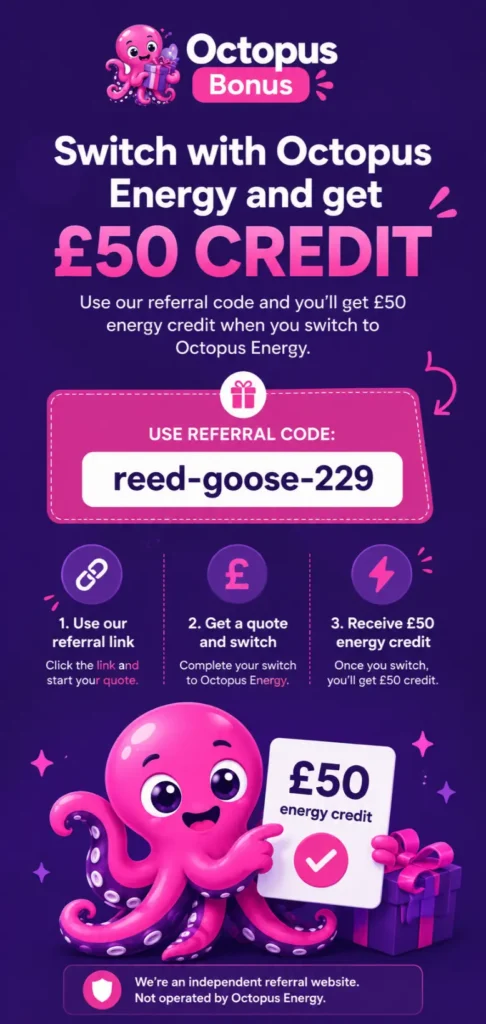
Eligible new domestic customers can currently receive £50 energy credit through the Octopus refer a friend scheme.
Our referral code is: reed-goose-229
The standard home referral currently provides £50 credit to the new customer and £50 to the existing customer whose qualifying referral is used.
If you’re ready to switch, you can visit our Octopus Energy referral code page to access the referral link and see the current offer.
For a detailed explanation of how the reward works, when the credit is applied and who can use it, see our Octopus Energy refer a friend guide.
If you’re switching business energy rather than your home supply, don’t use the domestic information as your guide. Business referrals have a different offer, which we’ve covered separately in our Octopus Energy business referral guide.
And if you haven’t yet decided which tariff to choose, read our Octopus Energy tariffs guide before switching.
The £50 credit is useful, but our position throughout this Octopus review remains the same: decide whether Octopus and the tariff are right for you first, then use the referral offer if you’re going to switch anyway.
Octopus Energy Review FAQs
Is Octopus Energy good?
Octopus currently performs strongly compared with many UK energy suppliers. Citizens Advice gave it 3.67 out of 5 for customer service for January to March 2026, ranking it fourth. It also offers an extensive range of conventional and smart tariffs.
Is Octopus Energy worth it?
Octopus Energy can be worth considering if its current tariff is competitive for your household. It can be particularly interesting for EV, solar, battery and heat-pump households because of its specialist smart tariffs.
Should I switch to Octopus Energy?
Compare the current Octopus quote with your existing tariff and other suitable suppliers. If the price is competitive, the tariff suits your household and you value Octopus’s smart products or customer-service performance, there are good reasons to consider switching.
Is Octopus Energy customer service good?
Independent Citizens Advice data currently ranks Octopus fourth for domestic supplier customer service, with an overall score of 3.67 out of 5 for January to March 2026. Individual customer experiences can still vary.
Is Octopus Energy cheap?
Octopus isn’t automatically the cheapest supplier for every household. Prices depend on your region, consumption and tariff. Obtain a personalised quote and compare the actual unit rates, standing charges and tariff conditions.
What is the best Octopus Energy tariff?
There isn’t one tariff that is best for everybody. Fixed or Flexible may suit customers wanting a conventional tariff, while Tracker, Agile, Intelligent Octopus Go and Cosy target different consumption patterns and technologies.
Is Octopus Energy good for electric cars?
Octopus is particularly worth investigating for EV owners because it offers Intelligent Octopus Go, which is designed around smart EV charging and low-cost overnight electricity.
Is Octopus Energy good for solar panels?
Octopus offers export tariffs and smart products designed around solar generation and battery storage, making it worth comparing for solar households.
Does Octopus Energy have smart tariffs?
Yes. Octopus currently offers several smart tariffs, including Tracker, Agile Octopus and Intelligent Octopus Go, alongside products for heat pumps, solar generation and battery storage.
Does Octopus Energy have many complaints?
All major energy suppliers receive complaints. Citizens Advice recorded 21.3 complaints per 10,000 Octopus customers in its January to March 2026 customer-service data and awarded Octopus 3.5 out of 5 in its “fewer complaints received” category.
Is Octopus Energy billing reliable?
Citizens Advice reported billing accuracy of 96.44% for Octopus smart-meter bills and 94.19% for traditional-meter bills in its January to March 2026 data. However, Octopus received 3.4 out of 5 overall for the wider billing and metering category.
Is Octopus Energy regulated by Ofgem?
Yes. Octopus Energy operates within the Great Britain energy market regulated by Ofgem and is subject to the rules and requirements applying to licensed energy suppliers.
Can I get a referral bonus when switching to Octopus?
Eligible new domestic customers can currently receive £50 energy credit through a qualifying Octopus referral. Our referral code is reed-goose-229. Check the current referral conditions before switching.
Is Octopus Energy better than British Gas?
That depends on what you’re comparing. Tariffs, customer service, smart products and individual prices can differ, so a proper comparison should use current data rather than assuming one supplier is universally better.
What are the main disadvantages of Octopus Energy?
Potential disadvantages include a tariff range that can be complicated for new customers, smart tariffs that require active energy management or compatible technology, and the possibility of billing, meter or account problems, as with other large suppliers.
Conclusion
After looking at customer service, tariffs, smart technology, billing, renewable energy and customer feedback, our overall Octopus Energy review is positive.
There is independent evidence behind some of the strongest points. Citizens Advice ranked Octopus fourth for domestic customer service for January to March 2026, with an overall score of 3.67 out of 5. The company also offers one of the most developed ranges of smart tariffs, with products covering EV charging, wholesale-linked pricing, heat pumps, solar export and batteries.
There are still reasons to compare carefully.
Octopus isn’t automatically the cheapest supplier. Smart tariffs can be more complicated than conventional energy deals. Billing and smart-meter problems still affect some customers, and not everybody needs the technology-focused features that make Octopus distinctive.
So, is Octopus Energy good? Based on the evidence we’ve reviewed, it is a strong energy supplier to consider.
Is Octopus Energy worth it? It can be, particularly when the tariff matches your household’s consumption and technology.
Should I switch to Octopus Energy? Only if the actual tariff, price and overall proposition make sense for you after comparison.
That’s the distinction that matters.
Don’t switch because somebody tells you Octopus is universally the best energy supplier. Don’t switch solely because there is a £50 reward. Compare what you would actually pay and what you would actually receive.
If you’ve done that and decided Octopus is right for you, the referral reward becomes a useful additional benefit.
Decided Octopus Energy Is Right for You?
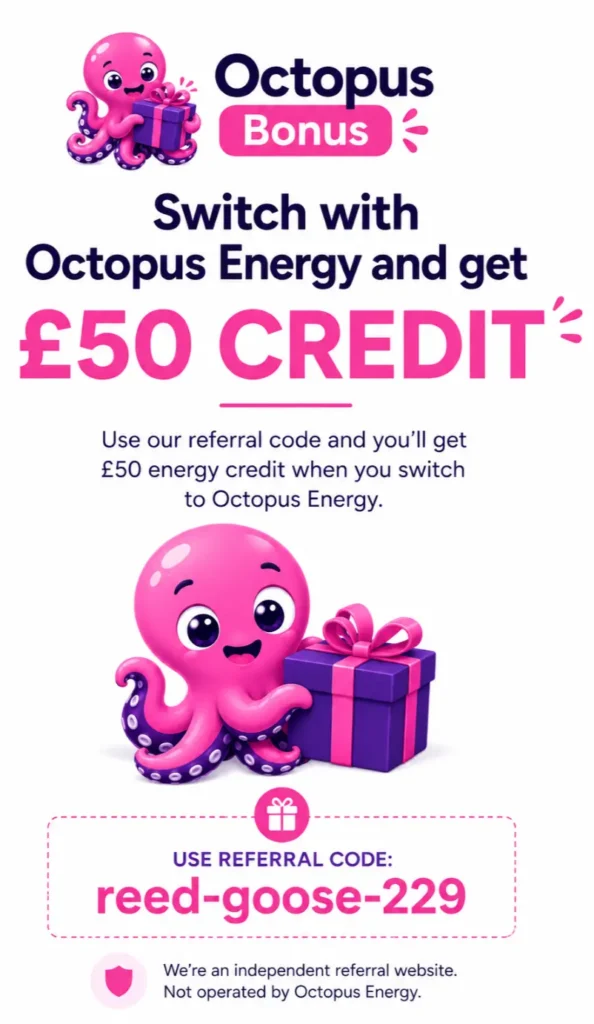
Eligible new domestic customers can currently receive £50 energy credit through a qualifying referral. Referral code: reed-goose-229
Visit our Octopus Energy referral code page to access the referral link, or read our Octopus Energy refer a friend guide if you want to understand exactly how the reward works before switching.
Still deciding? Our Octopus Energy tariffs guide provides a more detailed comparison of fixed, flexible and smart tariff options.
Switching a business rather than your home? See our Octopus Energy business referral guide.
Information checked: 18 August 2026. Energy tariffs, referral rewards, customer-service rankings and product terms can change. Check current tariff information and your personalised quote before making a switching decision.